Own Your Words on the Web

More details about this document
Identifier
https://virginiabalseiro.com/talks/own-your-words-on-the-web
Modified
Authors
Virginia Balseiro
License
CC BY 4.0
Language
English
Document Type
Slideshow
Topics

Own Your Words on the Web

ETH Prague, Prague,

Virginia Balseiro's avatar Virginia Balseiro https://virginiabalseiro.com/#me @yesvirginia

One step forward, two steps back

๐Ÿ•ธ๏ธ Addicted to Interwebs. Dial-up and pay as you go. Mom wasn't happy.

โœจ Met a stranger on the web also a fan of Michael Jackson. Introduced me to Webmasters Manual. Uploaded first webpage to Geocities - super popular.

๐Ÿ‘‹ ...but Geocities went down and along with it my content.


Web stack is not fun. Too many frameworks, libraries, hoops to jump. Expensive!

Parable of the boiling frog

If it is easier to use a third-party, people are going to use it. ๐Ÿธ ๐Ÿฒ

Even when it is:

  • violating their privacy
  • mining the fabric of their Being
  • extracting the fruits of their intellectual creative labour

Who owns the means of production?

You grant to YouTube the right to monetize your Content [...] This Agreement does not entitle you to any payments. - YouTube

You grant us a separate, worldwide, royalty-free, transferable, sub-licensable, and non-exclusive license to use, reproduce, modify, distribute, adapt, publicly display, and publish your blocks, username, and profile. - WordPress / Automattic

Survives termination of this Contract with regard to content provided prior to termination. - LinkedIn

Royalty-free, perpetual, irrevocable, and worldwide. - Substack

Surplus value, extracted

Platform Revenue Creator Share Reality Check
YouTube ~$50B from ads + subscriptions 55% of ads to creators 3% make enough to be above US poverty line
Meta ~$160B ~1% $2B paid to creators
Medium private $28M (2017-2021) Average writer: ~$50/month
WordPress ~$710M โ€” Sold user content to OpenAI/Midjourney w/o consent
Sources: Influencer update, Business of Apps, TechCrunch, 404 Media, Medium, Automattic

anyone being (technically) allowed to say anything about anything

Self-publishing

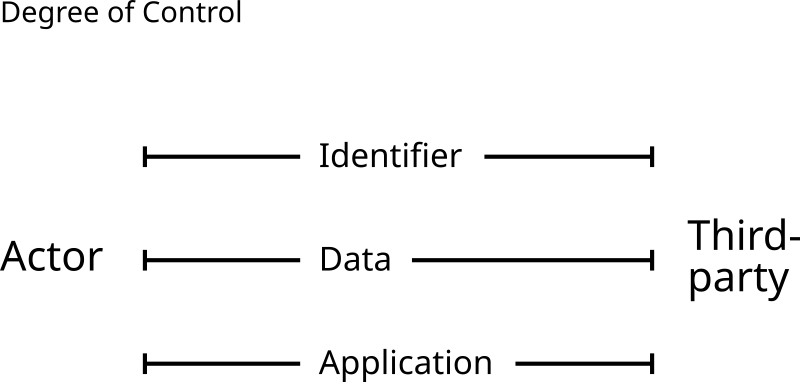
Self-publishing means you control:

  • the identifier people find you at
  • the storage your work lives in
  • the applications you use to write and share it.

The obvious way to do this is: host your own website - harder than it should be.

So what options are left for sharing your words on the web?

What do we control?

Degree of Control, Linked Research on the Decentralised Web, 2019

In practice...

Platform reality
Identifier https://EvilPlatform.com/you - they assign and revoke
Data Constrained expression; Zip exports but limited read/reuse
Application Third-party clients exist until the API is closed. (Reddit killed Apollo by raising API prices)

Control how?

URI ownership

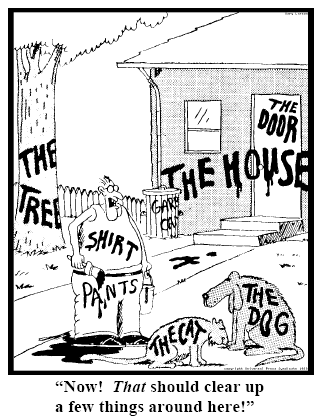
Now! That should clear up a few things around here. URIs are social agreements. https://yoursite.org/article

The Far Side, 1987.

Where does the data live?

  • Personal storage: you hold it, you grant access, you can move it
  • The data outlives the app that wrote it.
  • Open formats, and portable.

Choose preferred app

  • Switch apps without losing your data.
  • Multiple apps reading the same data.
  • New apps can be built without permission.
  • Walking away costs nothing.

How do we work with an already decentralised web?

Solid Project

Solid Protocol enables agents to do read-write operations against storages.

WebID: an HTTP URI that people and groups use to identify themselves.

Storage: affords agents controlled access to resources.

Authentication: OIDC-based mechanism to authenticate people and clients.

Authorization: ACL-based mechanism to grant access to resources.

Notifications: structured messages about (social) activities.

Applications: domain-centric, decoupled from data and storage.

How can we apply this for owning our words?

Authoring and annotation system

People still write. Convenience keeps us on centralised platforms.

There is a need for alternatives to giant tech companies that give users back their autonomy and control.


dokieli is a browser-based authoring system for creating, publishing, and annotating articles based on open web standards.

It does not collect, transmit, track, or store any data about its users.

People choose where their content goes. All of it.

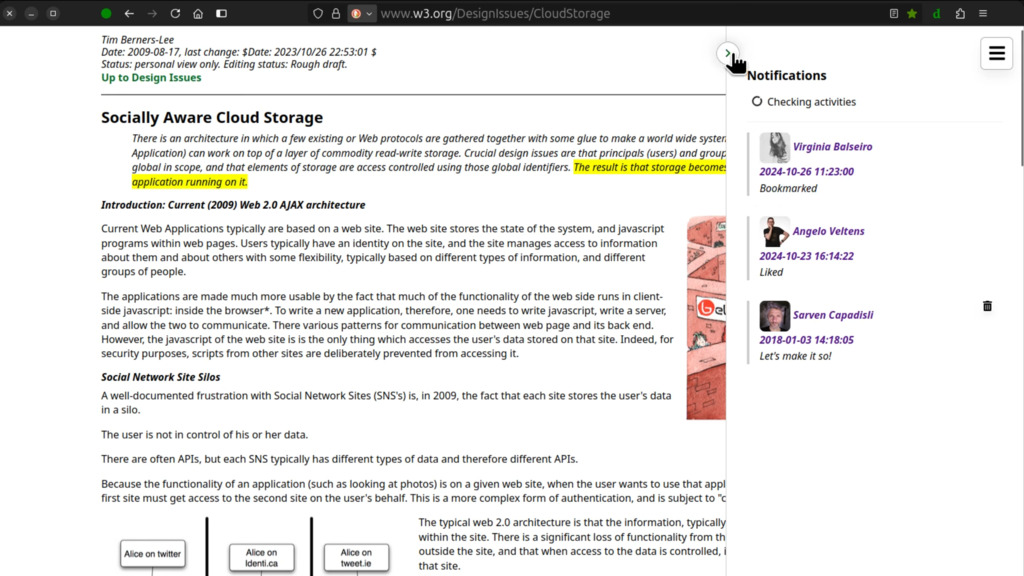
Create and Annotate on the Web

Screenshot of dokieli's annotations on an article on the web

An alternative is possible

dokieli is an example of an applications that

  • respects user's autonomy to decide where to store their data
  • respects user's privacy by not storing or tracking any of their data
  • allows users to identify themselves as they prefer
  • allows users to interact with others on their own terms

Food for thought

  • What (future) are we building?
  • Is it safe, responsible, and ethical?
  • Who/what might actually end-up controlling stuff?
  • How can we balance public and private identities, anonymity, meronymity, ..?
  • What are the ideological and technology traps?
  • How can we get from ideas to reality, fast enough to make a difference?

Seize the means of digital production